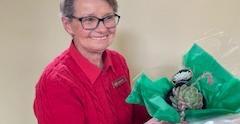
Christine comes to us from the ‘Beyond the Garden Gate’ program which is run by Royal Botanic Gardens Victoria.
Christine provided an informative and interesting presentation on the Arid Collection at the Royal Victorian Botanic Gardens (RBGV), Melbourne, and more generally on succulents and cacti. She pointed out that all cacti are succulents, but not all succulents are cacti.
Succulents store water to protect themselves from the dry. They photosynthesise at night, by opening their stomata to absorb carbon dioxide. Succulents have adapted to low water availability, poor soil conditions and a variety of climatic conditions.
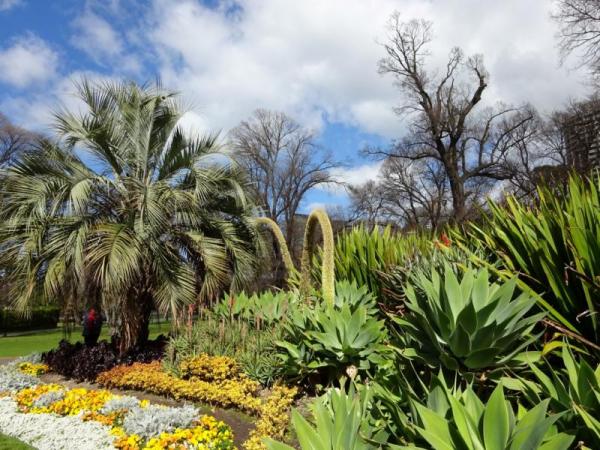
The succulents and cacti are spread across several areas in the Royal Botanic Gardens Melbourne, including in the Guilfoyle’s Volcano, the Arid Garden, the Grey Garden and around the Tecoma Gate. The Arid Garden was redeveloped by Andrew Laidlaw to accommodate the donated Robert Field Collection. This Collection was begun by Robert’s father, Ralph, starting with plants from the RBGV, and it grew to a collection of 1200 varieties of cacti and succulents. After Ralph, Robert grew and nurtured the collection on his father’s farm. Many of the plants were originally sourced from plants collected by the Blossfeld expedition which moved through South America and Mexico, collecting plant samples, in the 1930’s.
Cacti are native to the Americas and have thick fleshy stems with scale or spines. Textured stems can direct water towards the roots of the cacti. Spines grow from areoles and direct the sun away from the stems, as well as acting as a means of defence. Cacti may also have hairs covering their spines. Some cacti flower at night, thereby preserving the water in the petals. The night flowering cacti are pollinated by bats and moths, attracted by the flowers’ strong, musky perfume.
The ‘prickly pear ‘cacti were introduced to Australia with the first fleet, to act as a host for the cochineal insect, needed for the establishment of a cochineal industry. However, the cacti quickly spread and became an invasive weed. Australia does have some native succulents such as pigface, sturt desert pea and the leafless rock wattle.
Christine’s photos demonstrated a wide variety of succulents, varying in size from miniature to very large. She also illustrated with photos, how succulents could be contrasted effectively in our gardens, suggesting that they are usually best planted in clumps rather than individually.
We are grateful to the RBGV, for providing our guest speaker for a small fee, under their ‘Beyond the Garden Gate’ program.